On June 14, 1590, Hachigata Castle opened without major battle. When we hear of a Sengoku castle falling, we may imagine fire and blood, but Ujikuni's final chapter was different. What stood there were letters asking that lives be spared and the bitter decision to protect without fighting.
Ujikuni was born in Odawara as a son of Hojo Ujiyasu, the third Odawara Hojo lord. Recent views tend to treat him as Ujiyasu's fifth son and the child of a concubine. While still young, he married Daifuku Gozen, the daughter of Fujita Yasukuni, and inherited the Fujita name. Before moving to Hachigata, he acted from Hanazono Castle as a young leader in northern Musashi.
From Fujita son-in-law to lord of Hachigata
As Uesugi Kenshin invaded Kanto almost every year under the banner of restoring it, Ujikuni stood on the northern Musashi front under the name Fujita Otsuchiyomaru. The young Ujikuni was supported by Miyama Gorobei Tsunasada. Recent research suggests that Tsunasada's sister was Ujikuni's birth mother, making the two uncle and nephew.
Tsunasada was trusted enough to receive a character from Hojo Ujitsuna's name, and he likely taught Ujikuni the Hojo way. Ujikuni later renovated Hachigata Castle and moved his base there sometime between 1564 and 1569. From there his battlefield expanded toward Kozuke, the Hojo-Uesugi alliance, Mimase Pass, the Otate conflict, and the Battle of Kanagawa River.
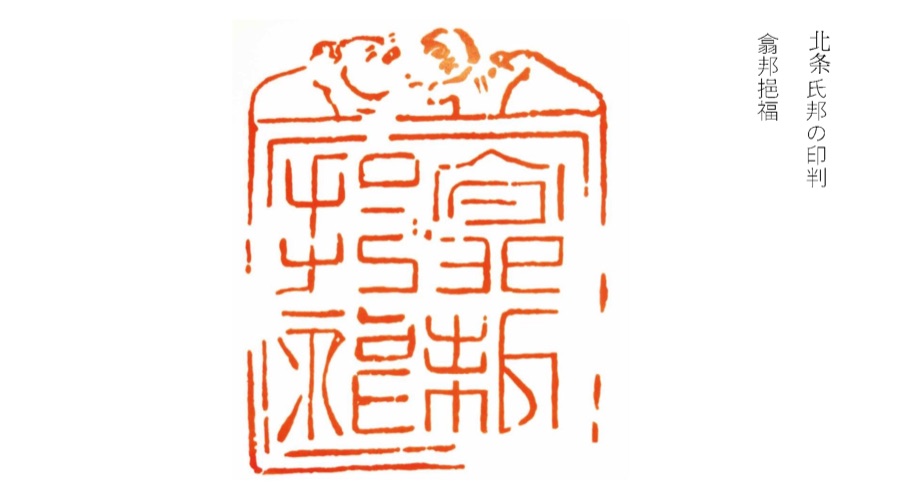
The Kyuho-Yufuku seal
One thing that cannot be omitted when reading Ujikuni is the seal Kyuho-Yufuku. The character ho is Ujikuni's ho, and fuku is also the fuku of his wife, Daifuku Gozen. The phrase is interpreted as countries gathering strength, like a bird folding its outstretched wings, and drawing in happiness. In discussion, it has even been compared to a kind of united-states concept.
At the same time, the seal shows Ujikuni's affectionate character. He is remembered as a rare Sengoku warrior who did not take concubines and cherished Daifuku Gozen to the end. Politically, the seal also showed connection to the Fujita house, but carving his wife's name into it makes his personality more dimensional.
Objecting to the Odawara strategy
In 1589, the Odawara Hojo prepared for confrontation with Toyotomi Hideyoshi by ordering powerful warriors across Kanto to take half their castle soldiers into Odawara Castle. The idea was to let the outer castles exhaust Toyotomi forces and then decide the war at Odawara itself.
Ujikuni objected. The plan would use the castles of Kozuke and northern Musashi, where he had built trust, as shields after they had lost half their soldiers and leaders. Commoners and land would be trampled. Ujikuni argued that he could not abandon his fellows, and he returned alone to Hachigata Castle.
Petitions that reached Hideyoshi
As Toyotomi attacks began, castles in Kozuke surrendered one after another. In early June, forces gathered near Oshi Castle and headed for Hachigata. In a letter dated June 5, Hideyoshi wrote that Hojo Awa no Kami, meaning Ujikuni, had sent various apologies. In another letter he wrote that Ujikuni had asked for lives to be spared at Iwatsuki, Hachigata, Hachioji, Oshi, Tsukui, and other castles.
Hideyoshi wrote as if he had not accepted the requests, yet in the latter part of a letter to Chikushi Hiromon he said that because Ujikuni strongly wished it, the matter of lives was under consideration. Ujikuni's voice had not failed to arrive. It had arrived and entered Hideyoshi's judgment.
What remained after the bloodless surrender
On June 14, Hachigata Castle surrendered without battle. Ujikuni was spared, took the tonsure, and lived in seclusion at Shoryuji before being placed with Maeda Toshiie in Kaga. In Odawara, Ujimasa and Ujiteru were ordered to commit seppuku, while Ujinao and Ujinori were exiled to Koyasan. The Hojo age ended.
Ujikuni died in Kaga in 1597. At his funeral at Shoryuji, it is said that the procession stretched beyond the mountains. The ending of a castle opened without fighting is a story of defeat, but also the memory of a man who did not betray retainers or people.